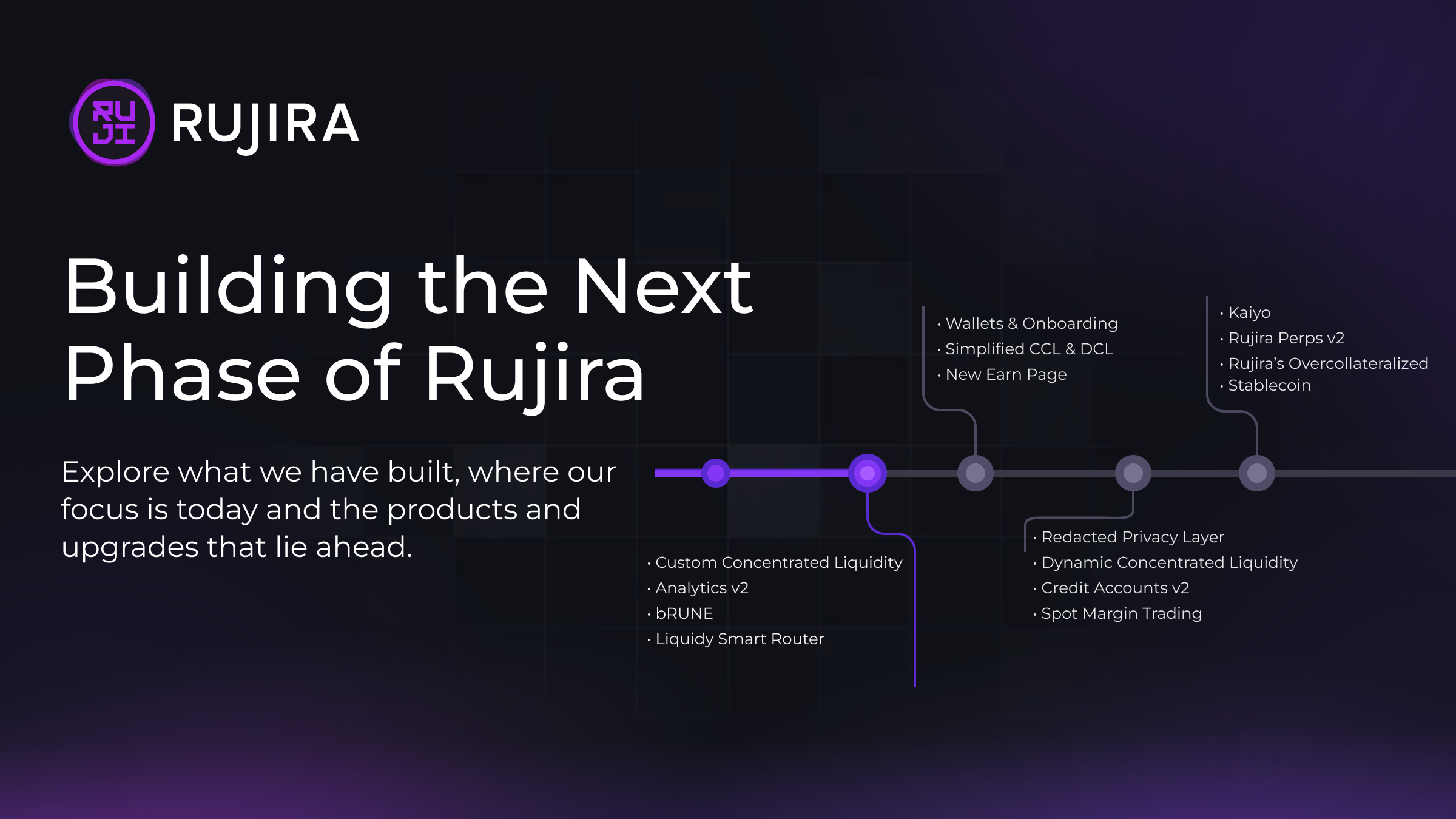
With THORChain v3.21 expected to go live on Mainnet later this week and the App Layer getting closer to resuming, we want to share an update on our roadmap for the coming months, while also looking further ahead at how we can build a more sustainable, reliable, and secure foundation for the future.
The Highlights
Our deployment on THORChain remains our #1 priority, with the focus on resuming the App Layer, achieving long-term stability, and continuing to build alongside THORChain and its Node Operators.
Introducing Kaiyo, our own high-speed, fully sovereign blockchain built with Commonware, giving us more flexibility to build and scale Rujira while maintaining strong alignment with THORChain and its Node Operators.
No new token or dilution. RUJI will remain at the center of both deployments, with opportunities to earn protocol revenue on THORChain and Kaiyo.
Our product priorities include improving the Virtualization Strategy, launching DCL, and introducing Credit Accounts v2 and Margin Trading, while working toward Perps and Kaiyo.
Major UI/UX and analytics improvements are coming, including easier wallet onboarding, Rujira Connect, Vultisig integration, smarter swaps, simplified access to CCL and DCL, and Analytics v2.
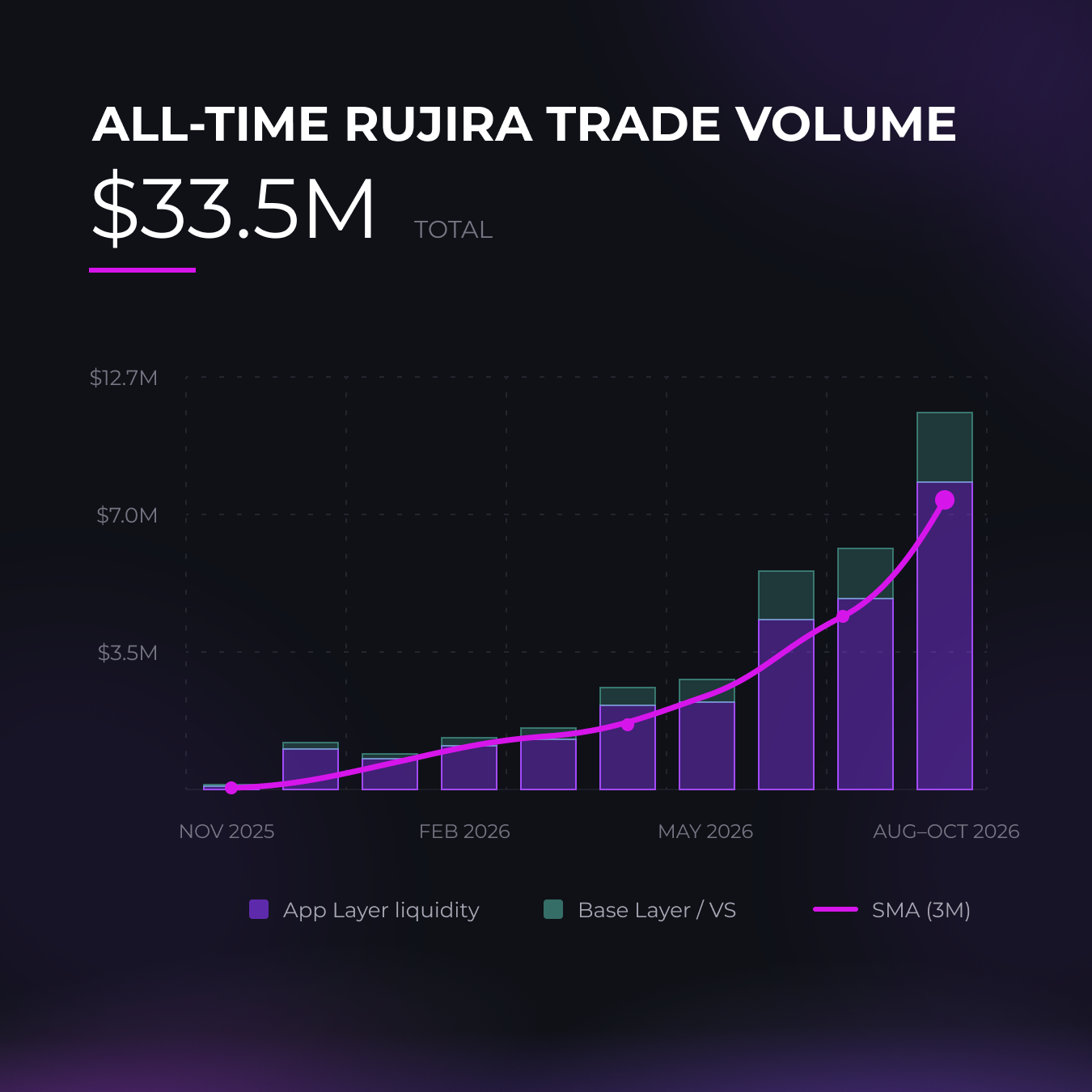
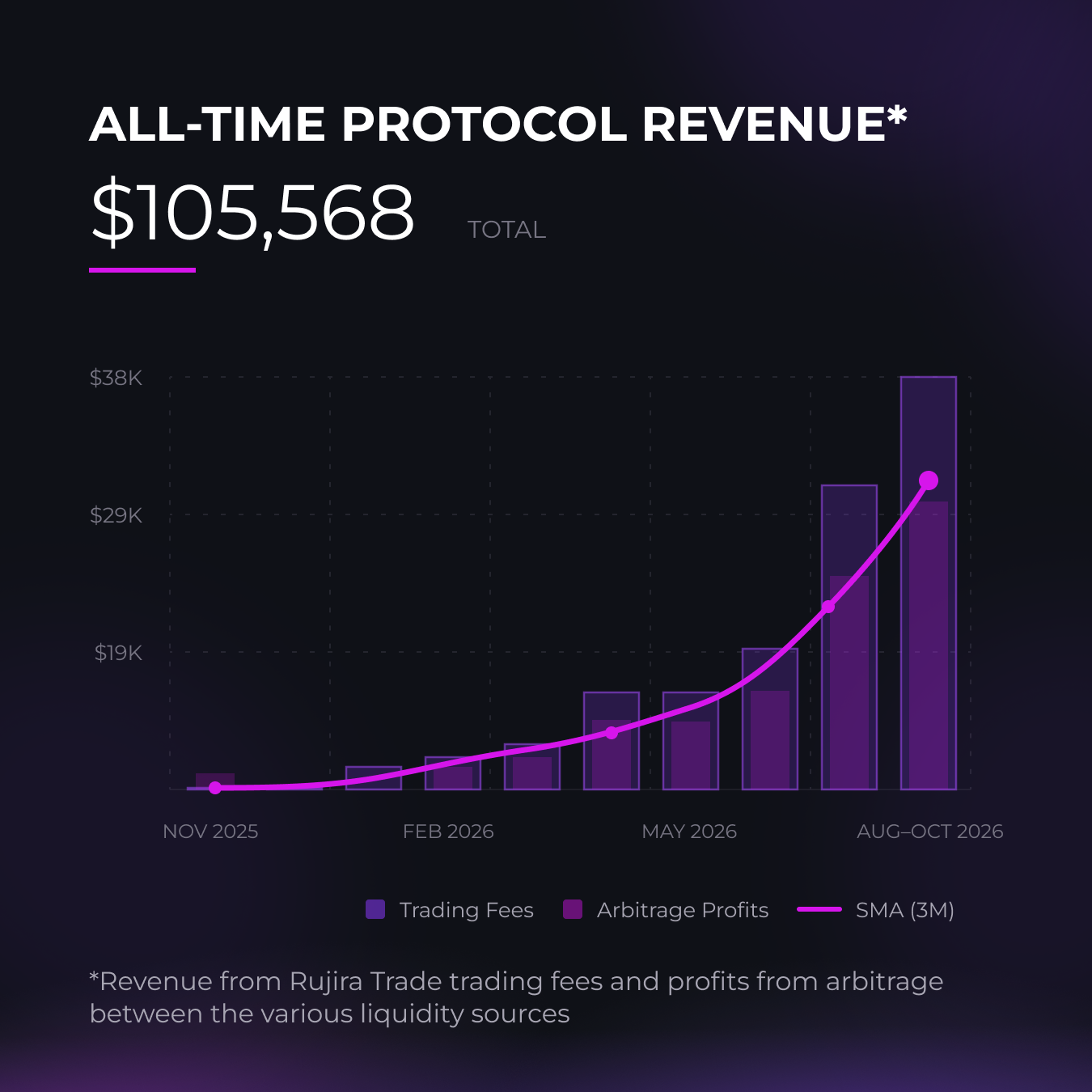
The past few months have shown us the potential of what we are building with Rujira. We have continued expanding our DeFi suite, welcomed more users, and seen strong growth in trading volume and protocol revenue. With over $33M in trading volume and $105K in protocol revenue, momentum was building, and we were starting to see our different products come together and demonstrate the value of an interconnected DeFi suite.
Unfortunately, we have also faced our fair share of turbulence, which brought much of that momentum to a halt. From the THORChain Asgard exploit and CosmWasm issues to the Maya Protocol exploit and, most recently, the CCL position ownership vulnerability, it's been a challenging period.
The resulting halts have slowed down product releases, interrupted users, and created uncertainty for everyone involved. We understand the frustration this has caused, and we share it. But while these events have highlighted some important challenges, our north star hasn't changed.
We want to build an omnichain DeFi suite that makes decentralized finance accessible to anyone, regardless of which chain or wallet they come from. To get there, we need a secure, stable foundation that allows us to keep building and scaling sustainably.
Building truly permissionless, decentralized cross-chain finance has never been the easy path, and the past few months have certainly been a reminder of that. But through all the setbacks, the conviction of the people behind Rujira and THORChain continues to stand out. From developers and Node Operators to users and community members, we have seen people continue to show up, solve problems, and push forward because they genuinely believe in what we are building together. That kind of commitment is something we deeply value, and it's what makes both communities special.
That shared conviction was also reflected in the vote on ADR-31 a couple of months ago. It wasn't just about the economic relationship between THORChain and Rujira, but also about the future we want to build together. The strong support reinforced something we firmly believe in. THORChain and Rujira are stronger together, combining THORChain's decentralized cross-chain infrastructure with Rujira's DeFi products to build something genuinely unique in this industry.
We have already seen the growth and potential of what we are building, and the foundation is there. Our goal now is to find a sustainable path forward that builds on that momentum, allows Rujira to continue growing, and works in everyone's best interests while staying true to the community, the Node Operators, and the principles that brought us here.
With that said, let's clear up some confusion around the different chains before diving into what we are working on over the coming months.
🟣 Let's talk about chains
There's been quite a bit of discussion about different chains lately, and understandably, it's becoming a little confusing. So let's break down what each one means for Rujira and where our priorities lie.
⚡️ THORChain
First things first: THORChain remains our primary focus, and our commitment hasn't changed.
Our vision of an omnichain DeFi suite still very much lives and breathes with THORChain and its Node Operators. We have spent years building toward this, and we have every intention of continuing to build out products on the App Layer.
Our immediate priority is getting the deployment fully stable and delivering the next wave of products, including Dynamic Concentrated Liquidity, Credit Accounts v2, Margin Trading, and hopefully Perps, alongside big improvements to onboarding, trading, and the overall user experience.
At the same time, we have learned that there are limitations to what we can safely build on the current infrastructure. The halts, our dependency on THORChain's Base Layer release process, and limitations around block times and compute availability have proven to be significant obstacles, particularly for high-leverage products like Perps, where a prolonged halt could quickly result in potentially unrecoverable bad debt. We can adapt these products to work within those limitations to a certain extent, but we also need to be realistic about the long-term risks.
This doesn't mean we are abandoning those products on THORChain. We will continue working toward their release, with some adjustments to make them better suited to the infrastructure. For example, this could mean offering margin trading with up to 3.3x leverage instead of full-blown Perps with much higher leverage and risk. Ideally, we still want to launch Perps on THORChain eventually, but we will need to see a prolonged period of stability first.
We will get into the detailed roadmap for the THORChain deployment further down.
⭐️ Aztec
Aztec is a separate chain being developed by the Maya Protocol team, with its own infrastructure, token, and DeFi ecosystem.
The plan is for Aztec to introduce financial products inspired by what we have built with Rujira, adapted to their own chain. We will support the team with advice and consultation where needed, but the development and implementation will be handled by the Maya team themselves.
This allows us to share what we have learned and bring the products and ideas behind Rujira to another ecosystem without taking significant development resources away from our own priorities. More details will follow as the collaboration progresses.
🟣 Kaiyo
Now for something we have been working on behind the scenes, and probably the biggest addition to our long-term vision.
Kaiyo will be our own fully sovereign, THORChain-aligned blockchain, built specifically for the next generation of omnichain DeFi.
Over the past few years, we have learned an enormous amount about building decentralized financial products, working with native cross-chain assets, and the limitations of existing blockchain infrastructure. Kaiyo is our opportunity to bring all those lessons together into a chain built specifically around what we want to achieve, with much more control over development, execution, and releases.
Importantly, Kaiyo isn't an attempt to move away from THORChain. We are designing it to remain closely aligned with THORChain, its Node Operators, and the economic relationship established through ADR-31.
A sovereign chain, built with Commonware
Kaiyo will operate independently, with an architecture similar to THORChain and Maya Protocol. Its own decentralized network of Node Operators will run chain clients, observe transactions across connected chains, and collectively manage vaults and signing.
This means users will be able to deposit assets directly into Kaiyo's own decentralized vaults, rather than relying on THORChain's secured asset infrastructure. And because the entire chain will have its own governance and development process, we won't be dependent on another chain's releases to make changes or introduce new functionality.
We are building Kaiyo using Commonware, a modern framework that provides the building blocks for consensus, networking, and communication between nodes, while giving us much more flexibility in how the chain itself operates.
If you would like to read up on Commonware, this is a good place to start: Introducing Commonware.
Rather than trying to fit our products into an existing blockchain architecture, we can design the architecture around the products.
We are targeting 50ms slot times, providing traders with ordering commitments up to 200 times per second and making Kaiyo well suited for Perps, trading, and other financial products where fast execution matters. We will also be able to build functionality like our orderbook, oracle infrastructure, automated strategies, and cross-chain execution directly into the chain itself.
One example is outbound transactions. Today, smart contracts on THORChain can't freely initiate outbound cross-chain transactions. With Kaiyo, we will be able to incorporate that behavior directly into the chain, making more complex financial operations possible.
We are also developing much more compact transaction instructions, allowing users to interact with advanced functionality directly from connected chains. Even advanced trading orders based on oracle prices can fit within Bitcoin's strict limits on transaction data.
The result is a much more flexible foundation for users, integrators, and arbitrageurs, without compromising on the decentralized, permissionless nature of the network.
Built around our products and users
Kaiyo will be a purpose-built blockchain to host Rujira products, aiming to provide higher stability and faster settlement times for an improved user experience. The financial products will be familiar to anyone who's used Rujira: an orderbook exchange, CCL and DCL, lending, borrowing, and Perps, all tightly integrated into one ecosystem.
But we will also be able to take things further.
One example is drift orders, a new type of order that allows users to define an intent relative to an oracle price, with a specified amount of flexibility around that price. Rather than worrying about the exact execution path, users can focus on the outcome they want, bringing us closer to intent-based trading.
Another important part of the vision is our own decentralized stablecoin, backed by blue-chip crypto assets, which we aim to integrate deeply into the financial products built on Kaiyo.
On the user experience side, we want to abstract away as much of the underlying blockchain complexity as possible. This includes more flexible signing options such as passkeys, familiar wallet integrations, EVM-compatible signing, and account and fee abstraction, so users don't constantly have to think about networks, gas tokens, or complicated transaction flows.
Because we will control the chain's architecture, we can design all of this to work together from the beginning. And on the UI side, much of what we are already building for the THORChain deployment can be reused, so we are certainly not starting from scratch.
Keeping RUJI and THORChain aligned
One of the most important parts of Kaiyo is its economic model, particularly how we maintain alignment with THORChain.
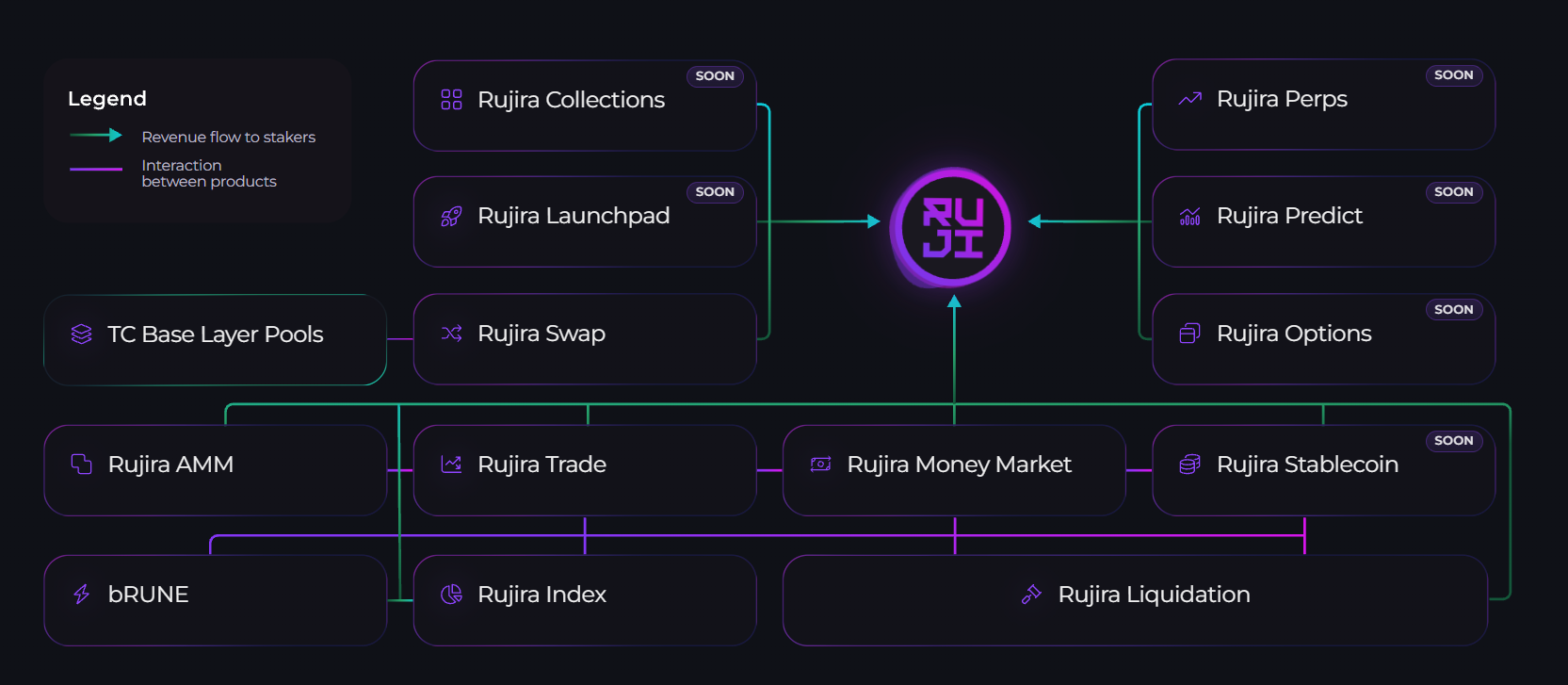
We don't intend to introduce a new token. RUJI will remain at the center of the ecosystem, with protocol revenue coming from both the THORChain deployment and Kaiyo.
The proposed model revolves around bonding. RUJI will be bridged over from THORChain, and users can choose to bond it with Kaiyo Node Operators, giving holders a share of protocol revenue and governance rights while helping secure the network. The original RUJI token and its mint authority will remain on THORChain.
Kaiyo will also have a flexible bonding module, similar to Terra's Alliance module, where governance can approve additional assets, such as RUNE, to participate in bonding, with their own weights for rewards and voting. This allows us to maintain the economic alignment between THORChain and Rujira.
For example, purely for illustration, governance could vote to allocate 10% of revenue and voting power to RUNE, meaning people would have the option to bond either RUJI or RUNE with Kaiyo nodes. If just one person decided to bond any amount of RUNE with Kaiyo, they would receive the full 10% revenue share allocated to RUNE. As Kaiyo's revenue grows, the incentive to bond RUNE with Kaiyo increases, creating a new source of demand for RUNE and helping take supply off CEXs.
There's also an operational side to this alignment.
We are designing Kaiyo with relatively low hardware requirements, assuming you already run a THORChain node. The goal is to make it easy for existing Node Operators to run the network without requiring a dedicated machine. These are operators who have already demonstrated their commitment to decentralized, permissionless cross-chain infrastructure, making them a natural fit to run Kaiyo.
We aim to get Kaiyo's software integrated into the existing THORChain node-launcher tooling, allowing operators to opt in with minimal additional setup and attract bond from RUJI (or RUNE) holders alongside their existing THORChain operations. This will allow them to leverage their existing machines to earn a second stream of income in the form of fees paid by Kaiyo bonders.
The exact economic parameters and implementation will develop alongside the chain, but the direction is clear: we want Rujira's growth to create opportunities for the wider ecosystem.
The role of RUJI
RUJI will continue to be Rujira's revenue-sharing token, earning a share of the fees generated across all Rujira products.
RUJI's supply remains the same at 100M, with no new token or dilution.
RUJI will be fungible between THORChain and Kaiyo, meaning people will be able to move back and forth through deposits and withdrawals. THORChain will be treated as an observed chain, just like any other connected network.
RUJI holders will have the option to either stake on THORChain to earn a share of Rujira revenue generated on THORChain or bond on Kaiyo to earn a share of the revenue generated on Kaiyo.
To learn more about RUJI, visit rujira.network/ruji-token.
Where are we today?
While Kaiyo is a substantial undertaking, it's not just an idea on paper. The core architecture is already taking shape, with a working single-node implementation and a multi-node testing environment.
There's still plenty to build, test, and validate before it's ready for public use, and we are not going to rush that process. Security and stability are a big part of why we are building Kaiyo in the first place.
For now, our priority remains getting the THORChain deployment stable, refining our product offering there, and improving the user experience to drive growth and adoption. Kaiyo will continue developing alongside that work as our longer-term path toward a more resilient and flexible infrastructure.
We will share more as development progresses.
🟣 What's next for Rujira on THORChain?
With the direction of the different chains hopefully a little clearer, let's get into what we will be working on over the coming months.
Our immediate focus is getting the THORChain deployment stable, bringing the next wave of products to users, and making Rujira much easier to use. Here's what that looks like.
🛠️ Products
Virtualization Strategy (VS)
Our foremost priority on the product side is getting the Virtualization Strategy back up and running sustainably.
The VS plays an important role in connecting liquidity between the THORChain Base Layer and the Rujira App Layer. Before the halt, we experienced several significant price deviations that caused the strategy to lose money, which obviously isn't sustainable.
We have already been working on improvements to make the strategy more efficient and reduce unnecessary losses. Getting this right is a priority, as the VS is a key part of our liquidity infrastructure.
Dynamic Concentrated Liquidity (DCL)
Next up is DCL, our automated liquidity strategy that manages concentrated liquidity positions based on market conditions.
We had already started testing it on Mainnet with the BTC/USDT.TRON pair before the latest halt, and we have been making adjustments based on those results, alongside extensive research including backtests and Monte Carlo simulations.
Since it's a completely new strategy, there's quite a bit of testing involved in getting it right. Once we are confident in its performance, the next steps are an audit, final UI integration, and the official launch.
DCL strategies will usually quote at or very close to the oracle price on one side, making them an important part of bringing Base Layer pool prices closer to market prices and improving the competitiveness of quotes.
DCL is also an important prerequisite for Perps, as it will help provide the liquidity needed for that product.
Credit Accounts v2 and Margin Trading
Credit Accounts v2 will unlock much more flexibility in how users manage and use their assets across Rujira.
This includes Margin Trading and the ability to use more types of positions as collateral, such as open limit orders and CCL/DCL liquidity positions.
Instead of having assets tied up in separate products, users will be able to make more efficient use of their capital, including borrowing against existing positions to leverage their returns or hedge against market movements.
We will also be improving the UI around Credit Accounts to make these features easier to understand and manage.
Perps
Ideally, we want to keep Perps on the THORChain roadmap, but we need to make sure they can be offered safely, both for users and for the protocol. To do that, we will first need to observe a prolonged period of stability.
We might need to make some adjustments to the original design and restrict the maximum available leverage or open interest to reduce risk and the amount of bad debt in the event of a prolonged App Layer halt.
The rest of the design would remain largely the same, with funding markets instead of traditional funding rates and tight integration with Rujira Trade.
The core code is already there, but aside from chain stability risks, we first need sufficient liquidity. That's why getting DCL live is an important prerequisite, along with growing revenue from spot trading so we can use POL to bootstrap Perps markets.
⭐️ UI, Wallets & Onboarding
We have also got several big UI upgrades coming up, with a particular focus on making Rujira easier to use, especially for people who are new to the ecosystem.
We have spent a lot of time building the products themselves, but we know that getting started hasn't always been as easy as it should be. Our onboarding has largely been optimized for the Cosmos ecosystem, while our vision reaches far beyond that.
Someone coming from Ethereum, Bitcoin, Solana, or another ecosystem shouldn't have to jump through multiple hoops and be forced to install a new Cosmos-compatible wallet just to try Rujira.
Wallets & Onboarding
Several improvements are underway to make the experience much more straightforward:
Rujira Connect will make it easier to manage different chains with hardware wallets like Ledger, Trezor, and Keystore, while giving integrators a simpler way to support these wallets without maintaining separate integrations for every chain.
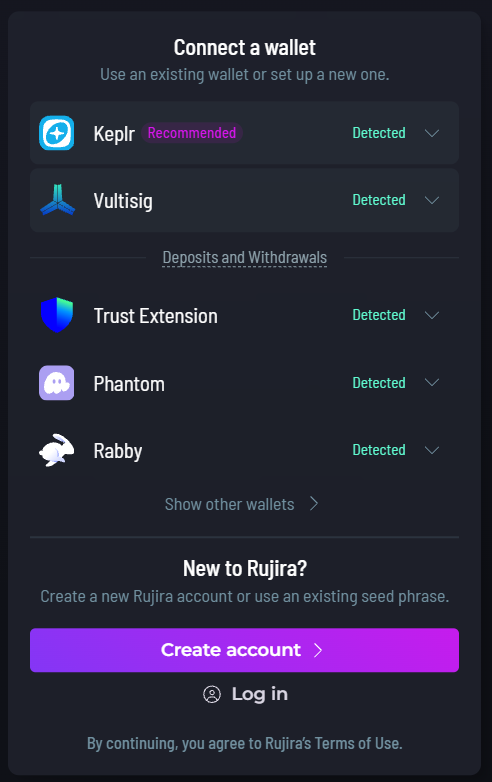
Vultisig's Fast Vault technology will be integrated directly into Rujira, allowing users to create a new wallet using their email or import an existing one directly from their browser, without needing an additional extension or app.
With improved EIP-712 support, compatible wallets such as MetaMask, Rabby, Trust Wallet, Phantom, Binance Wallet, and others will be able to sign THORChain transactions and access Rujira's full range of products without requiring users to install another wallet.
The overall wallet experience will also get an upgrade, with better WalletConnect support, more supported wallets, an updated connection flow, custom wallet names, and dedicated portfolio views.
The goal here is simple: regardless of which ecosystem you are coming from, getting started with Rujira should be straightforward.
RUJI Swap & Liquidy Smart Router
RUJI Swap was one of our first products, originally built as a frontend for THORChain swaps. It does exactly what it was designed to do, but with the rest of Rujira growing, it's time for a proper upgrade.
A major part of this will be integrating the Liquidy Smart Router, built by Liquidy DAO.
The router navigates different markets on the Rujira Trade orderbooks to find efficient execution paths, potentially using multiple markets to complete a swap.
By combining this with THORChain's native swaps, RUJI Swap will be able to compare routes and find the best available price for users, without requiring them to understand the underlying liquidity sources.
Importantly, the Liquidy router is built on top of Rujira Trade orderbooks and can only be used for secured-asset-to-secured-asset swaps. It's designed for Rujira users who have already deposited assets on Rujira. It does not and cannot compete with THORChain on L1-to-L1 swaps.
To further align ourselves with THORChain, we will also take this opportunity to lower the affiliate fee to 0 bps for L1-to-L1 swaps and keep it at 20 bps for any swap involving a Secured Asset.
Credit Accounts & Margin Trading
Credit Accounts are becoming increasingly important as we expand our Money Market and introduce more debt-based products.
We are improving how they are presented and managed, with tighter integration into the wallet modal and Portfolio so users can easily understand their assets, collateral, debt, and available balances.
Part of this work is also the introduction of Margin Trading, which will use the Money Market in the background to enable leveraged positions and advanced trading or hedging strategies.
Simplified CCL & DCL
CCL and DCL are powerful products, but they can also be overwhelming for new users, with plenty of parameters and a steep learning curve.
We are working on simplified interfaces for both, where users only need to make a handful of straightforward decisions, choose how much they want to deposit, and get started. More experienced users will still have access to the advanced settings.
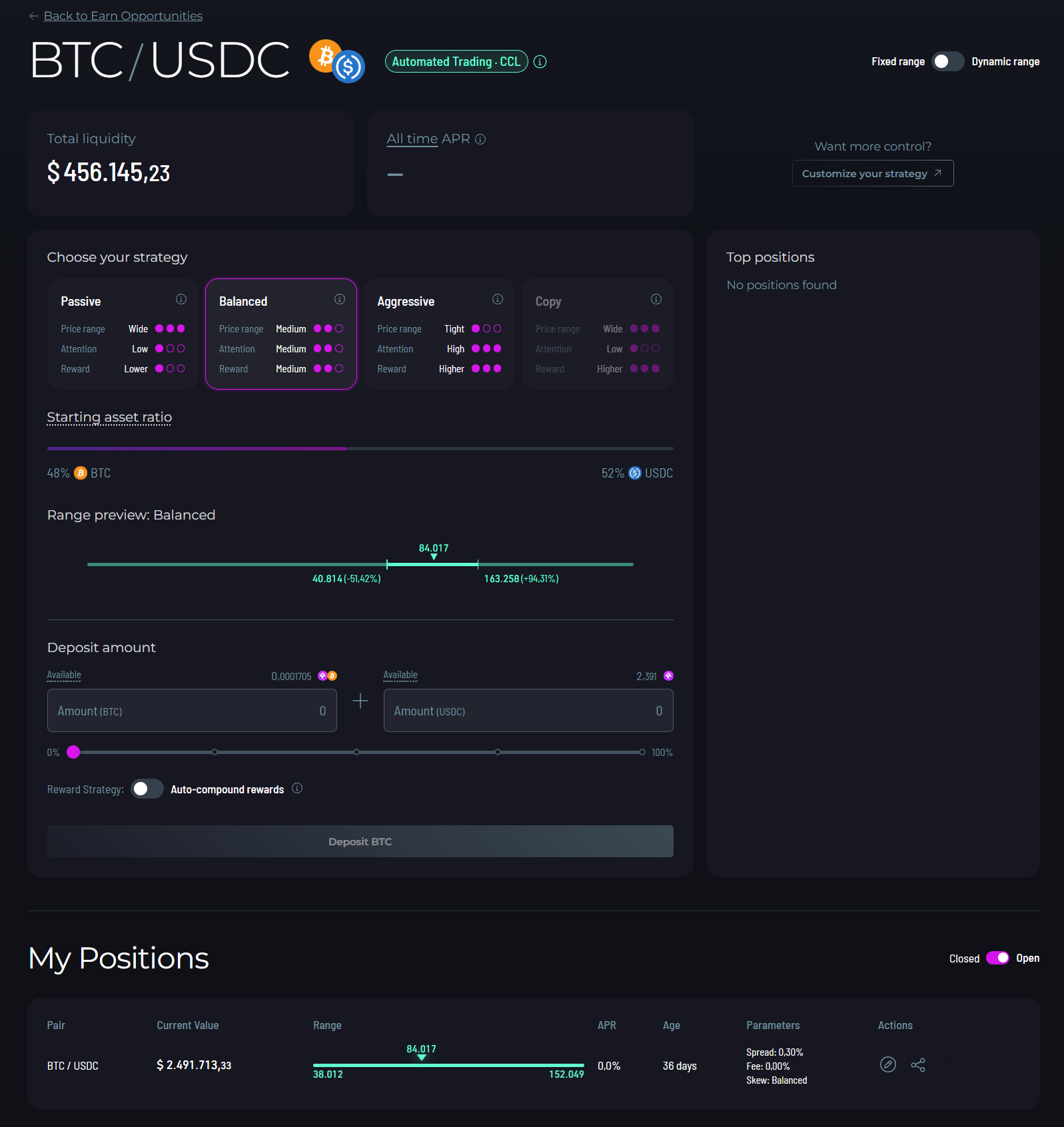
This will become even more useful once the Liquidy Smart Router is integrated, allowing users to zap into liquidity positions using other supported assets without manually swapping into the correct tokens first.
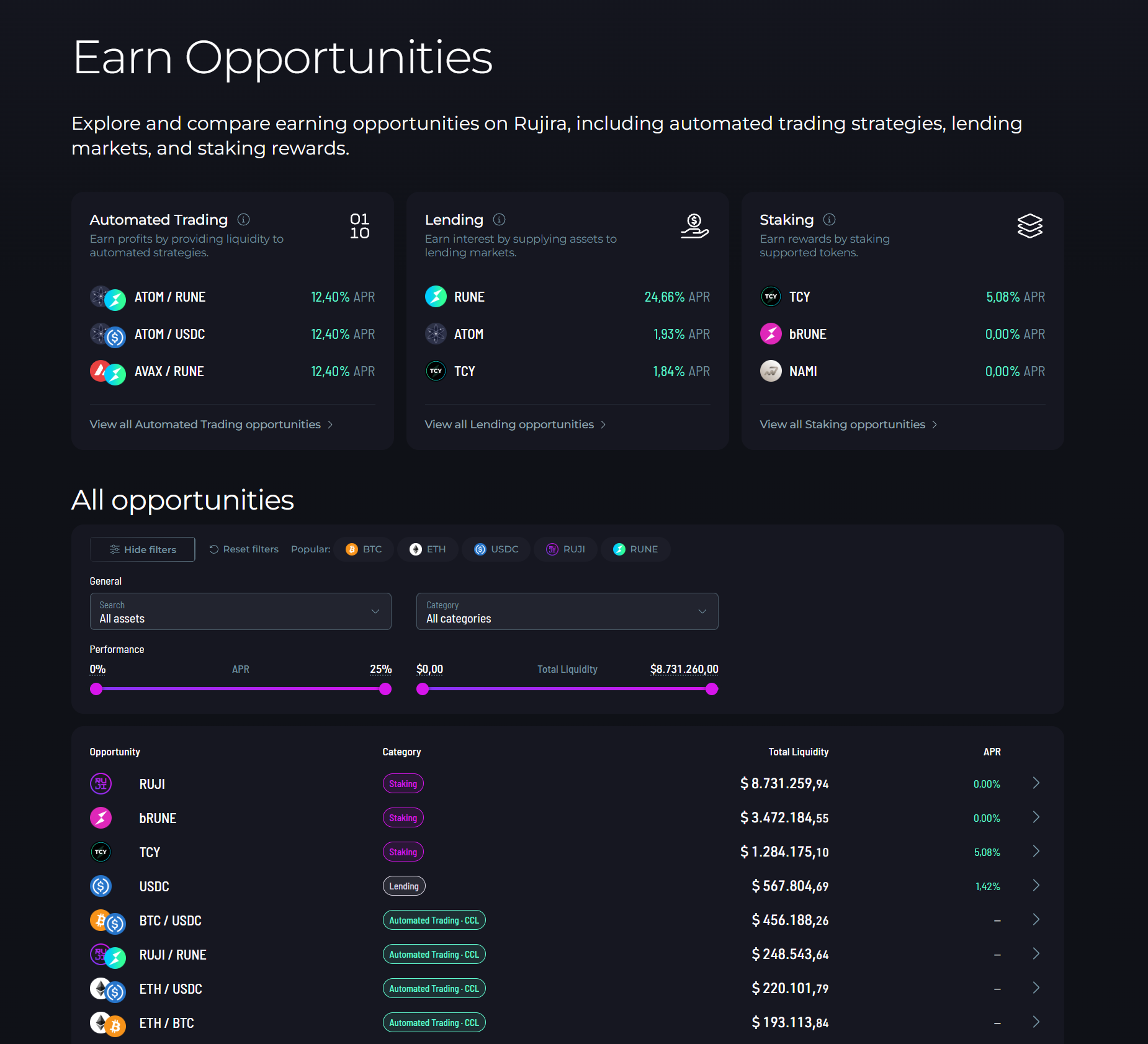
A New Earn Page
The Strategies page is also getting a revamp and will evolve into a more comprehensive Earn page, bringing together the different ways users can earn yield across Rujira.
Whether you are interested in Lending, Staking, or automated liquidity strategies, you will be able to find and compare opportunities in one place, including the available options for the assets you already hold.
Rather than having to navigate through multiple products, we want users to get a clear overview of what they can do with their assets across the entire DeFi suite.
📊 Analytics & Infrastructure
Analytics v2
Over the past year, we have been building out the analytics dashboards across Rujira, but we have also run into several limitations with the existing infrastructure.
Some of these are visible to users, particularly slow loading times and missing functionality, while others have made it difficult for us to build new features efficiently.
This is why we started working on Analytics v2 a couple of months ago, which will give us a much more flexible foundation for analytics across our products.
For users, this will unlock long-requested features such as account-level analytics, order and trading history, and more detailed insights into individual positions. We will also continue improving the existing dashboards, particularly their loading performance, reliability, and usability.
Rujira Ex
At the same time, we are building Rujira Ex, a set of tools designed to make Rujira's data and functionality easier to access and integrate.
The goal is to give developers, AI agents, integrators, and other third parties a simple framework for accessing Rujira data, tracking on-chain events, and building their own tools, automations, and integrations without having to build everything from scratch.
Severin will be among the first to test it in practice, and we will continue improving the framework based on real-world usage.
🟣 Looking ahead
We know that sharing another roadmap won't mean much unless we can deliver on it. After the past few months, earning back confidence starts with getting the App Layer back online, keeping it stable, and delivering the products we have been working on.
Our priorities are clear:
Get the THORChain deployment stable
Deliver the products and improvements we have been working on
Make Rujira significantly easier to use.
In parallel, we will continue building Kaiyo as our longer-term path toward a more flexible and resilient infrastructure.
The important thing is that these aren't competing directions. We still very much believe in the vision that brought Rujira and THORChain together, and we want to build on that relationship by offering Rujira users an alternative environment where they can use higher-risk products such as Perps without fearing a multi-week halt that could put their own accounts or the solvency of the entire protocol at risk.
The challenges of the past few months have made it clear where we need to improve, but they haven't changed our ambition. If anything, they have reinforced the importance of building something that can keep growing without constantly being held back.
We have got a lot of work ahead, but our belief in what we are building and the people building it with us is as strong as ever. We are excited about what's coming, and our focus now is on turning those plans into real progress that everyone can see and benefit from!
Thanks for sticking with us. ❤️